
By: Karolina Mroczek, Grade 12
After a year of anticipation, audiences are flocking to theaters to see the sequel to Wicked. Although only filmed last year, Wicked: For Good was intentionally released later to keep audiences engaged. While the first part of the film received great praise from critics, Part Two seems to have fallen short. Many agree that the set design and vocal talent displayed by the lead actors were well-maintained, but the overall acting and attention to detail have declined. Both halves of the story were filmed together, leaving viewers wondering what went wrong.
Fans of Broadway’s Wicked were aware that the movies would be divided into Act I and II. However, like traditional musicals, Act II of Wicked is shorter than Act I. This is reflected in the new film, which is approximately twenty minutes shorter than the first part. While this may not be a daunting difference, it is clear that filler was used in an attempt to match the runtime of Act I. In fact, four new songs were included in the soundtrack. While well-written, they are not relevant to the storyline. The only exception is “Every Day More Wicked,” which is a recap of Act I. When creating a film adaptation of a musical, it is unnecessary to add multiple songs’ worth of filler; if the musical sufficiently conveyed the plot, then it does not make sense to add onto it.
Aside from the hour of fluff, Wicked: For Good displays weaker acting than its predecessor. Ariana Grande (Glinda) seems to have a good relationship with co-star Cynthia Erivo (Elphaba), but this chemistry is not visible with other characters. For example, when Elphaba and Fiyero (Jonathan Bailey) declare their affection for each other, they lack the necessary romantic connection needed to make the scene believable. The kiss they share shortly seems forced, awkward, and uncomfortable. This appears to be a downgrade from last year’s Wicked, which was full of energetic acting from beginning to end.
Perhaps the most notable (and concerning) observation audiences have made is the skinny, unhealthy appearance of Wicked’s lead actors. Users on social media compared pictures of cast members Cynthia Erivo, Ariana Grande, and Michelle Yeoh before and after the filming of Wicked, noticing stark differences in body shape and extreme weight loss. Many comments claim that this level of thinness should not be highlighted in a children’s movie, as it encourages unrealistic and unhealthy beauty standards in young viewers.
Wicked: For Good has notably declined in terms of critic reviews. More specifically, Rotten Tomatoes rated it at 67 percent, more than a 20 percent decrease compared to last year’s film. IMDb’s rating dropped from a 7.5 to a 7/10, and Metacritic’s initial 73% score was reduced to 58%. This change is explained by the general audience agreement that the sequel was underwhelming, dull, and poorly executed in respect to the original plot of The Wizard of Oz. Viewers say that after stripping away the elaborate set design and special effects, the movie was a weak representation of Oz. They add that it was only well-received by those who watched it solely because it featured celebrities with strong reputations. Despite negative reviews, the film is still considered a success, having made $226 million in its opening weekend and surpassing its $150 million budget.
Wicked is one of my favorite Broadway musicals, but I am unfortunately disappointed by the second act of its film adaptation. I agree with the sentiment that it has significantly declined in quality compared to Act I. Personally, I believe that director Jon M. Chu took too many tasks combined with creative liberties, making for a sloppier movie. Many parts of the plot were irrelevant, such as glimpses into Glinda’s childhood and her current life after Elphaba’s departure following “Defying Gravity.” I prefer the open-ended nature of the musical, which addresses major plot points with thorough detail, allowing for the audience to interpret its ending with more creativity. The musical ends with Elphaba faking her death and leaving Oz with Fiyero, leaving Glinda to run the kingdom herself. While this happens in Wicked: For Good, it is not well-executed. Elphaba shares a corny monologue about how she wishes she could tell Glinda she was alive, but this is completely unnecessary and does not impact the story’s ending. Furthermore, it removes the open-endedness that audiences crave. I would rather watch a slightly more elaborate and exact replica of the musical than sit through numerous irrelevant scenes and plot points that were not mentioned in the first place. I cannot count the amount of times I checked my watch or yawned while in the theater last week.
Wicked: For Good was an unfortunate culmination of the “Untold Story of the Witches of Oz.” The vibrant and aesthetically pleasing imagery does not make up for the decline in performance and plot. Oz is better depicted onstage and in between two covers.
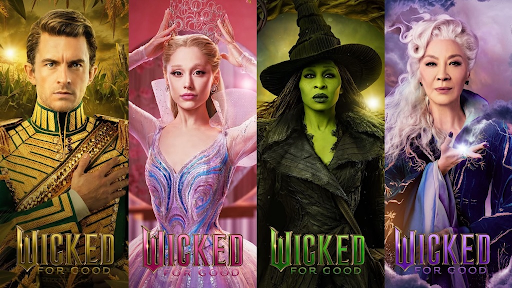
Image from: https://theaterfansmanila.com/wp-content/uploads/2025/11/Wicked-For-Good.jpg